Steel shelving provides a durable and practical storage solution, but choosing the right system requires more than comparing price and strength. For businesses exploring steel furniture in KSA, inventory, space, load requirements, picking needs, and warehouse conditions all deserve attention. Read on to see which factors can help you select shelving that works efficiently now and supports future storage needs.
How to Choose Steel Shelving for Your Saudi Warehouse
Choosing steel furniture in KSA requires more than comparing prices. Assess load capacity, dimensions, steel specification, configuration, layout, access, warehouse conditions, expansion needs, and safety before placing your order.
Assess Load Requirements
Start with the weight, size, and distribution of your inventory rather than choosing a shelf simply because it is labelled heavy duty. Check the documented load per shelf and total unit capacity, while considering whether goods will be evenly distributed or concentrated in specific areas.
Match Shelving Dimensions to Your Inventory
Measure your products before selecting shelf width, depth, height, and clearance. Boxes may need different dimensions from spare parts or long products. Also account for aisle space and access points, so your steel storage shelves in KSA use available floor and vertical space without restricting movement.
Select the Right Steel and Finish
Steel specification should reflect how and where the shelving will be used. Cold rolled steel can suit many indoor applications, while powder coating provides a durable finished surface. Galvanized or treated steel can be considered where humidity and corrosion exposure are higher, particularly in coastal or semi open facilities.
Choose the Right Shelving Configuration
Choose the configuration around how employees store and retrieve products. Open steel shelving suits visible, frequently accessed inventory, while closed shelving provides more enclosure. Adjustable systems work well when product sizes change. Heavy duty, mobile, and multi level systems can increase capacity when storage density or load requirements are higher.
Optimize the Warehouse Layout
Good warehouse steel shelving in Saudi Arabia should fit the entire storage plan, not just an empty floor area. Consider ceiling height, aisles, picking routes, emergency access, receiving and dispatch areas, and future expansion. Starter bays and additional bays can also make longer shelving runs easier to build gradually.
Consider Accessibility and Picking Requirements
High storage density is not always the best choice if employees struggle to reach products quickly. Consider product turnover, picking frequency, shelf height, visibility, and ergonomic access. Frequently picked inventory should be positioned where workers can retrieve it efficiently, helping reduce unnecessary walking, reaching, and handling during daily warehouse operations.
Account for Saudi Warehouse Conditions
Saudi warehouse conditions can vary significantly between temperature controlled facilities, dry indoor spaces, semi open areas, and coastal locations. Consider dust, humidity, temperature changes, corrosion risk, cleaning routines, and surface protection. The actual environment should guide the selected steel specification, coating, maintenance plan, and overall storage design.
Plan for Future Expansion
Your current inventory may not represent your warehouse requirements two years from now. Look for adjustable shelf levels, expandable runs, compatible additional bays, replacement components, and modular warehouse shelving systems Saudi Arabia. Planning for changing product sizes and increasing storage volume can prevent expensive replacement when the business grows.
Check Load Ratings, Installation and Safety
Before purchasing, ask for documented load ratings, shelf and frame specifications, installation requirements, and anchoring details where applicable. Confirm that the stated capacity reflects the intended loading conditions. Also check component compatibility, inspection requirements, maintenance guidance, and supplier documentation rather than relying on general claims about strength or compliance.
Steel Shelving vs Other Warehouse Storage Systems
Choosing between steel shelving and other storage systems depends on load capacity, product type, access method, durability, warehouse conditions, and handling equipment. Use this comparison to identify which option best fits your storage requirements.
| Storage System | Best For | Load Capacity | Access | Key Advantage | Main Limitation |
| Steel Shelving | Cartons, spare parts, tools, packaged goods | Light to heavy, depending on design | Manual picking | Strong, durable, adjustable, and versatile | Less suitable for palletized goods handled by forklifts |
| Pallet Racking | Pallets, bulk inventory, industrial stock | High to very high | Forklift or equipment assisted | Efficient vertical storage for palletized goods | Requires handling equipment and wider access planning |
| Plastic Shelving | Light goods, supplies, moisture exposed areas | Light to medium | Manual picking | Lightweight, easy to clean, and moisture resistant | Lower structural strength for demanding industrial loads |
| Wooden Storage | General storage, lighter goods, temporary applications | Light to medium | Manual picking | Simple and economical for basic storage | More vulnerable to moisture, wear, and changing warehouse conditions |
Best Steel Shelving Types for Saudi Warehouses
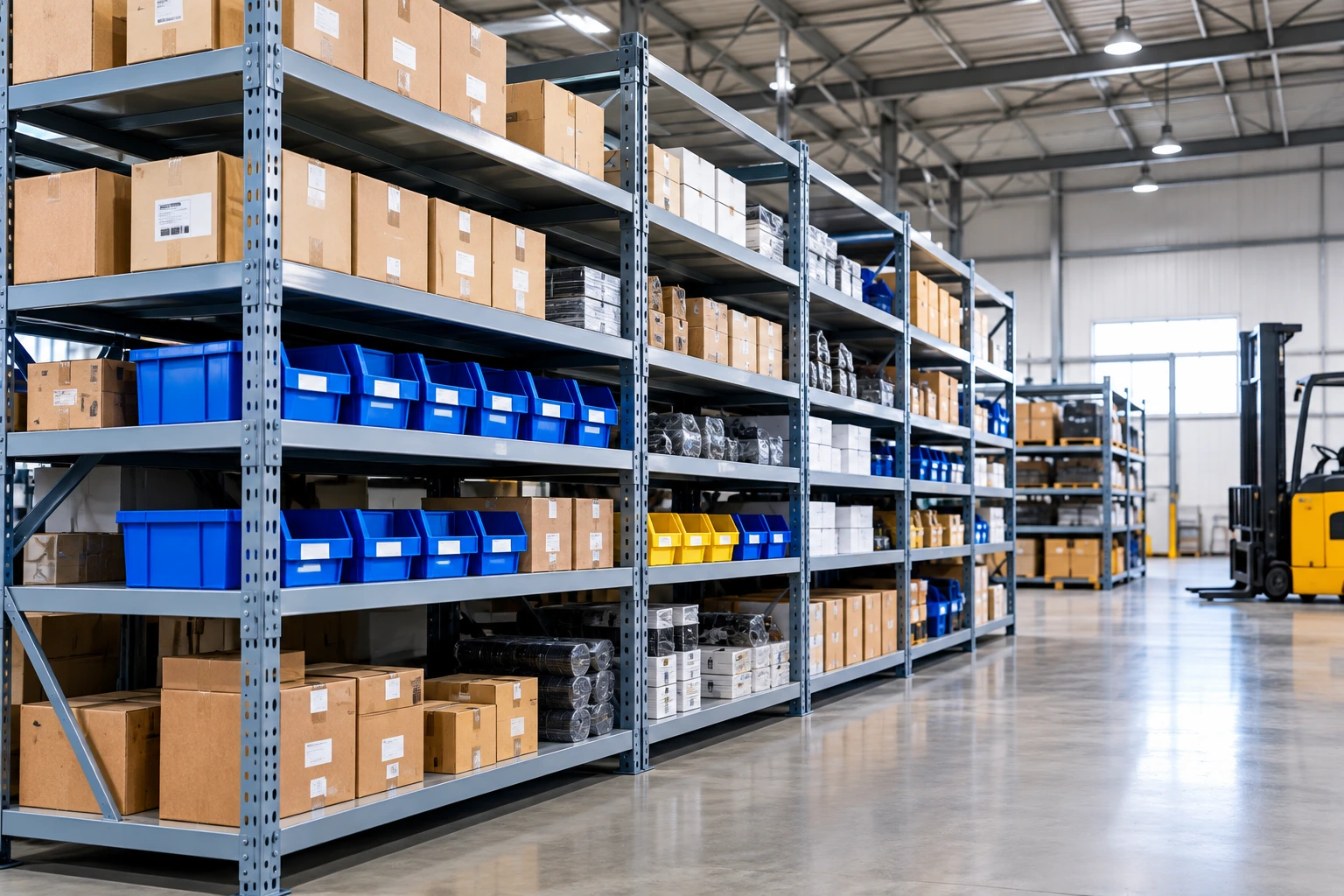
Boltless Medium Duty Long Span Racks: Suitable for cartons, archives, spare parts, and manual picking, with adjustable levels that make everyday warehouse storage easier to reorganize.
Heavy Duty Pallet Racks: Designed for palletized and heavier inventory where forklifts or other handling equipment are used, with capacity determined by the complete rack design.
Rack Supported Mezzanine Systems: Useful when ceiling height is available and businesses want additional usable storage levels without expanding the warehouse footprint.
Cantilever Shelving: Provides open front storage for long or irregular products such as pipes, timber, profiles, and other materials that do not fit conventional shelves.
Heavy Duty Steel Shelving: Suitable for dense industrial components, equipment, packaged goods, and heavier manually handled inventory requiring documented shelf capacity.
Adjustable Steel Shelving: A practical choice when product dimensions, stock levels, or storage requirements change regularly and shelf positions need to be modified.
Mobile Steel Shelving: Helps increase storage density in facilities where floor space is limited by reducing the number of permanent access aisles required.
Multi Level Steel Shelving: Makes better use of available vertical space where warehouse height allows additional storage levels and the structure is properly designed for the application.
Open Steel Shelving: Works well for frequently accessed inventory because products remain visible and employees can identify and retrieve stock without opening enclosed sections.
Specialized Steel Racking: Better suited to long, bulky, irregular, or palletized goods when conventional steel shelving cannot provide the required dimensions, clearance, or handling access.
Ready Made vs Custom Steel Shelving Which Is Better?
Ready made steel shelving is usually suitable when warehouse dimensions, product sizes, load requirements, and storage workflows are relatively standard. It can offer faster availability, simpler installation, and predictable configurations. Standard shelving works particularly well when businesses need practical storage without unusual dimensions, specialised loading requirements, restricted spaces, or complex warehouse layouts.
Custom steel shelving becomes more useful when standard sizes cannot use the available space efficiently. It can be designed around unusual warehouse dimensions, specific load requirements, irregular inventory, restricted areas, workflow needs, or planned expansion. Custom solutions may cost more, but they can provide better space utilisation when standard configurations leave significant unused capacity.
How Much Does Steel Shelving Cost in Saudi Arabia?
For standard steel shelving, current Saudi retail listings show individual units around SAR 250 to SAR 500, depending on dimensions, number of levels, finish, and load rating. Medium duty warehouse units commonly fall around SAR 400 to SAR 800, while larger or higher capacity systems can cost more. These figures represent individual shelving units, not complete warehouse installations.
For heavier warehouse storage, a practical budgeting range is approximately SAR 750 to SAR 1,500 or more per shelving unit, depending on capacity, dimensions, steel thickness, configuration, coating, accessories, delivery, and installation. Cost of custom steel furniture in KSA can exceed this range when engineering, special dimensions, unusual loads, or complex installation are required. Always request a complete quotation before comparing steel shelving price Saudi Arabia options.
What to Ask a Steel Shelving Supplier in Saudi Arabia
Before ordering steel furniture in KSA, use these questions to compare suppliers on technical suitability, not only price:
- What is the load capacity per shelf?
- Is the stated capacity based on evenly distributed weight?
- What shelf width, depth, and height options are available?
- Can shelf levels be adjusted?
- What steel specification and thickness are used?
- What finish or coating is applied?
- Is the system suitable for the actual warehouse environment?
- Is installation available?
- Are anchoring requirements included in the installation plan?
- Can the shelving system be expanded later?
- Are replacement shelves and components available?
- What warranty is provided?
- Can the supplier recommend a configuration using the warehouse measurements?
- Can the supplier provide technical specifications and load documentation?
- Does the manufacturer operate a documented quality management system such as ISO 9001?
When evaluating technical documentation, avoid treating a steel grade or certification name as proof that the complete shelving system is suitable. Grades such as Q235B or Q355B may be specified for structural components where applicable, while structural performance also depends on thickness, profiles, connections, bracing, shelf span, loading, and installation. Relevant FEM guidance or other applicable technical standards should be verified for the specific storage system.
Building Efficient Warehouse Storage With the Right Shelving
The best steel shelving is the system that fits your inventory, warehouse dimensions, working conditions, picking process, and future plans without creating unnecessary cost or unused capacity. Compare documented load ratings, dimensions, steel specification, finish, configuration, installation, and expansion options before choosing a supplier. A properly planned system can make steel furniture in KSA a durable and practical foundation for organised warehouse storage.